
How Often to Change Rotary Screw Compressor Oil?
Wondering when to change the oil in your rotary screw compressor? Here’s the recommended interval and oil type.
Sofiya
11/17/20253 min read
Introduction — The Real Risk of Delayed Oil Changes:
Changing oil in a rotary screw compressor isn’t just a scheduled task—it's the heart of maintaining the machine’s life and efficiency. While manufacturers suggest generic timelines (2,000 to 8,000 hours), these intervals are not a one-size-fits-all solution. What’s more concerning is that many compressor owners wait until it's too late—leading to severe damage that could've been avoided with regular oil monitoring.
1. Why Generic Oil Change Intervals Don’t Work:


A rotary screw compressor’s oil does four critical jobs: lubrication, cooling, sealing, and contaminant removal. The oil's job is not done until it gets contaminated or breaks down. Temperature alone can degrade oil 20-50% faster than the manufacturer’s suggestion. The key problem is that every operational environment (duty cycle, temperature, contaminants) affects how long oil lasts. For instance, if your compressor runs in a high-temperature environment (>40°C), the oil might need changing every 2,000–3,000 hours instead of 6,000 hours.
2. Key Factors That Impact Oil Life:
Temperature: Higher operating temperatures break down oil faster and can lead to premature wear on internal parts.
Dust and Moisture: High dust or humidity levels cause contamination of oil, accelerating its breakdown.
Duty Cycle: A continuous load wears the oil much faster than an intermittent duty cycle.
Oil Type: Synthetic oils last much longer than mineral oils, but only when maintained properly.
3. Why Oil Degradation Isn’t Always Obvious:
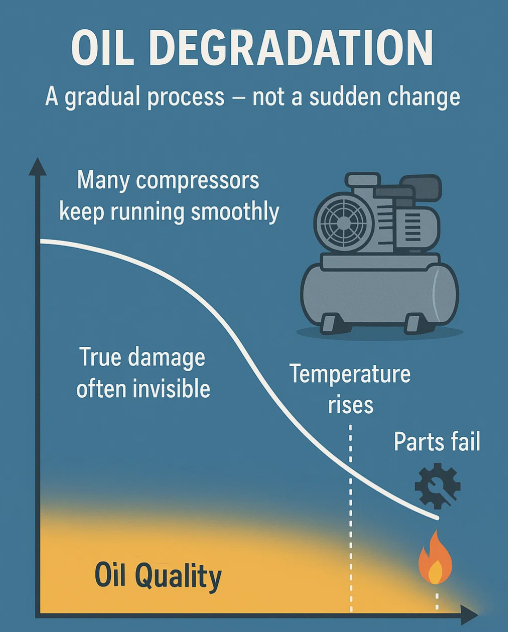

It’s important to understand that oil degradation is a gradual process—not a sudden change. In fact, many compressors keep running smoothly even when the oil quality is degrading, which delays the need for change. The true damage is often invisible until the temperature rises or parts fail, leading to expensive repairs.
4. Signs You Must Change Oil NOW:
Here’s a quick checklist to help you spot early signs that oil change is overdue:
Oil color: Dark or black oil means oxidation has already occurred.
Oil smells burnt: Indicates overheating, which speeds up oil degradation.
Visible particles: Sludge or metal particles in the oil signal wear inside your compressor.
Increased oil consumption: If your compressor suddenly consumes more oil, check for oil separator issues.
5. Oil Change Procedure (Step-by-Step):
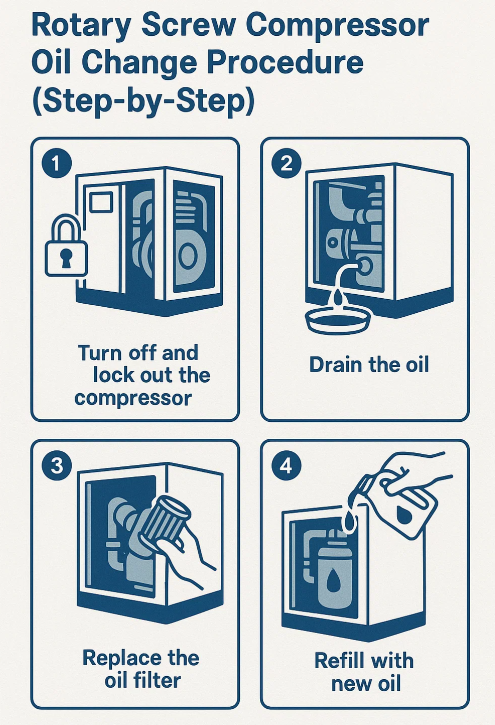
Warm-up the compressor for 5 minutes to ensure smooth draining.
Turn off and depressurize the machine before opening the oil drain valve.
Drain the old oil completely, and replace the oil filter.
Refill the correct type of oil, using OEM-approved synthetic oil if possible.
Check for leaks after restarting and recheck oil level after 30 minutes of operation.
6. FAQ — Users’ Real Questions:
Q1: Can I use automotive engine oil in my screw compressor?
No. Automotive oil cannot handle the heat and pressure of a rotary screw compressor.
Q2: Why is my compressor oil turning dark so quickly?
Dark oil often means oxidation due to high temperature or contamination.
Q3: How can I tell if my compressor needs oil analysis?
If you notice unusual odors, high temperature, or increased oil consumption, it’s time for an oil analysis.
7. Conclusion — Regular Oil Monitoring Is Key:
Maintaining proper oil levels and quality is critical for your rotary screw compressor's long-term health. Regular oil checks and analyses, along with adhering to manufacturer guidelines, can extend your compressor’s life and prevent costly repairs.